
How to Verify the Durability and Thermal Insulation Performance of Drinking Utensil Manufacturers' Products (Taking Sflask as an Example)
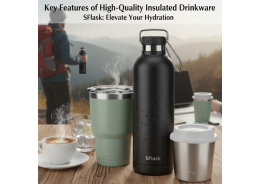
When choosing drinking utensils such as insulated cups and sports water bottles, durability (resistance to dropping, wear resistance, corrosion resistance) and thermal insulation performance (heat retention/cooling effect) are the core considerations. For a brand like Sflask that focuses on high-quality drinking utensils, consumers and enterprise purchasers need scientific methods to verify product performance. This article will combine the product features of Sflask to share practical tips for verifying the durability and thermal insulation performance of drinking utensils.
I. Material Verification: Quality Assessment Based on "Core Materials"
The durability and safety of tableware can be ensured from the very beginning by controlling the raw materials:
Stainless steel grade: Commonly used for food-grade drinking utensils is 304 stainless steel (resistant to corrosion and easy to clean), while high-end products (such as the medical-grade series of Sflask) may use 316 stainless steel (with stronger rust resistance and suitable for acidic beverages). This can be confirmed through product descriptions, customer service inquiries, or material testing reports (such as third-party laboratory certifications).
Process details: Check if the welding points on the cup body are smooth (without burrs or incomplete welding), if the inner wall is polished (to reduce bacterial residue), and if the sealing ring of the cup lid is made of food-grade silicone (without odor and suitable for high-temperature use). Sflask's products feature "seamless inner liner + vacuum insulation layer", which can enhance durability and insulation performance.
II. Durability test: Simulating real usage scenarios
Through "destructive + daily" tests, verify the durability of the drinking utensils:
Drop test: Drop the product vertically or at an angle from a height of 1.2 meters (simulating accidental falls) onto a hard surface (such as tiles) 3-5 times. After each drop, check: ① Whether it is deformed or dented; ② Whether the cup lid/sealing ring leaks; ③ Whether the inner liner is cracked. The vacuum body of Sflask, due to its "double-layer structure + reinforced steel ring", usually reduces the risk of deformation.
Wear test: Use keys, coins, etc. to lightly scratch the coating of the cup body (such as paint, titanium plating layer), and observe if the paint/delamination occurs. The surface treatment process of high-quality brands (such as Sflask) (such as "sanded anti-slip + scratch-resistant coating") will pass a 48-hour salt spray test and has a higher wear resistance level.
Corrosion resistance test: Pour acidic beverages (such as lemon juice, coffee) or salt water into it, seal it and leave it for 24-48 hours before pouring out. Observe the inner wall: ① Whether it is rusted or discolored; ② Whether there is any residual odor. The 316 stainless steel inner liner of Sflask contains the element Mo, and its corrosion resistance is 2-3 times stronger than 304.
III. Thermal insulation performance test: Speak with "temperature data"
The thermal insulation/cooling effect is the core competitiveness of drinking utensils. The testing method needs to be standardized:
Hot water insulation test: At a room temperature of 25℃, pour 95℃ boiling water and tighten the cup lid. Measure the temperature at 6 hours, 12 hours, and 24 hours:
Conforming standard (industry standard): 6 hours ≥ 65℃, 12 hours ≥ 50℃, 24 hours ≥ 35℃;
Actual test data for the vacuum series of Sflask (such as "Explorer Flask"): 12 hours of insulation maintains a temperature of 55℃+, and cooling (4℃ ice water) maintains a temperature of 10℃-. Over 24 hours.
Comparison test: Conduct the same test simultaneously with competing products of the same capacity and price (such as Yeti, Hydro Flask), record the temperature change curve to visually compare the insulation duration.
Extreme scenario verification: Test the cooling/insulation effect under extreme conditions (-10℃ in winter outdoor or 40℃ in high-temperature environment), observe whether the temperature fluctuation is too large.
IV. Certification and Compliance: Third-party endorsement "Safety Lock"
Authoritative certification is the "hard indicator" of quality, and attention should be paid to:
Food contact safety certification: such as FDA (USA), LFGB (Germany) certification, ensuring that the materials are non-toxic and do not release heavy metals;
Quality management system: ISO 9001 certification (standardized production process), ISO 14001 (environmental production);
Performance certification: such as CE (EU safety), NSF (USA hygiene), or reports from the brand's own laboratory's "2000 opening and closing tests" and "100,000 vibration tests".
Sflask's products have passed triple certifications of FDA, LFGB, and ISO 9001, and each batch of products undergoes "100% airtight testing" to ensure the vacuum degree of the insulation layer (the higher the vacuum degree, the longer the insulation lasts).
V. User Feedback and After-Sales: Long-term Use "Testimonies"
Apart from laboratory tests, real user reviews and after-sales policies can better reflect the durability of the product:
Evaluation Analysis: Check user reviews on Amazon, Sflask's official website, and social media platforms (such as Instagram #Sflask): ① Reviews for products used for over one year (such as rusting, leakage); ② Feedback on outdoor/officed settings (whether the product can withstand drops, and whether the insulation meets standards).
After-sales Support: Sflask offers a 2-year warranty + lifetime repair service. If the product is damaged due to quality issues, the inner liner/cup lid can be replaced free of charge, which demonstrates the brand's confidence in durability.
Six. Sflask's "Differentiation Advantage": From Design to Quality Inspection
As a professional tableware brand, Sflask's products have core advantages in durability and insulation:
Vacuum technology: The "rotational thinning process" is adopted to compress the thickness of the insulation layer (only 0.1mm), increase the vacuum degree (≤ 1.33×10⁻³ Pa), and reduce heat conduction;
Structural design: "Anti-scald cup mouth + anti-slip bottom pad", which not only enhances safety during use but also reduces the impact force during a fall;
Quality inspection process: Each cup undergoes "8 quality inspection procedures" (including drop, pressure, and temperature cycle tests), with the defect rate being lower than 0.3%.
Summary: Scientific verification, choose the "reliable" drinking utensils
To verify the durability and insulation performance of the drinking utensils, a four-dimensional analysis combining "materials + tests + certifications + user feedback" is required. For brands like Sflask, their transparent material description, strict quality inspection process, and long-term user reputation all provide guarantees for the product's durability and insulation performance. Before purchasing: ① Request a material report; ② Conduct small-scale tests; ③ Refer to similar user reviews and ultimately choose drinking utensils that are both "robust" and "have long-lasting insulation".




 English
 German
 French
 Russian
 Spanish
 Japanese
 Korean
 Portuguese
 Ukrainian
 Arabic
 Italian